Skip to content
  • Home
  • Digital Guide: Vanessa Dion Fletcher: BIG Doll | XWAT Naaniitus

Digital Guide: Vanessa Dion Fletcher: BIG Doll | XWAT Naaniitus

Curated by Julie Rae Tucker

November 20, 2025 – May 24, 2026

Download the Large Font PDF Guide

“I felt compelled and inspired to make my own doll, it would not be a sacred ancestor in the way that traditional Lunaapeewi dolls are, but making beadwork and quillwork is a way to care for my health and the health of my community.”

-Vanessa Dion Fletcher

BIG Doll is an exhibition that shows the process of making and creating from the heart, not the head. This exhibition is both profoundly personal and collaborative, open to audiences of all ages to participate in the design of an artwork. Dion Fletcher is inviting us to reflect on how our education systems are limiting our creativity. Our minds, bodies, and hearts are not uniform; we bruise when forced into prescriptive learning models.   

The process of beadworking is an entirely small and intimate act. Dion Fletcher makes her beadwork BIG so that audiences can understand how it’s made but also imagine the other worlds that this big beadwork exists in—illuminating the process of active learning so that others may join in.   

Beadworking and doll making are cultural practices meaningful to Indigenous teaching and learning, as Cathy Mattes calls them, a “cultural continuance,” 1 where “beads helped produce and transmit knowledge.”2 Throughout the exhibition and programming, the focus is on making and remaking, along with learning and unlearning, in a colourful space. This exhibition is curated by Julie Rae Tucker, a Lunaaweewi from Munsee, Delaware First Nation, and of settler descent. For the past five years, Vanessa and Julie have been learning Huluniixsuwaakan, the language of the Lunaapeewi in the Munsee dialect. 


Curated by Julie Rae Tucker

[1] Krasny, Elke, Sophie Lingg, Lena Fritsch, Birgit Bosold, and Vera Hofmann, eds. Radicalizing Care: Feminist and Queer Activism in Curating. Series of the Academy of Fine Arts Vienna 26. London: Sternberg Press, 2021.Pg.135
[2] Ibid.

Installation Images

Section 1: My friends/// Nii njoosak  

For the past five years, Vanessa and Julie have been learning Huluniixsuwaakan, the language of the Lunaapeewi in the Munsee dialect. They began learning on Zoom with the late Karen Dolson-Aya, a language teacher, and met other language learners from across Turtle Island.

These language classes led to long-term friendships and opportunities to travel to the annual “Munsee Language & History Symposium,” held on Lunaapahkiing (the name of the Munsee homelands in NY and New Jersey), Princeton University, and the Institute for Advanced Study.

The conference covers topics such as the repatriation of ancestor belongings from Museum collections, Lunaape veterans and survivors of residential schools, and language and culture revitalization.

During an event in 2023, Vanessa and Julie decided to work on a solo show of Vanessa’s work at AWE. They believe that working on a solo show with an artist and curator is built on trust and reciprocity.  

Section 2: The Title// xwataaniitus – big doll  

The John O’Meara Delaware-English Dictionary documents the word for “doll,” as naaniitus, which translates to  “guardian of health.” There is a doll collected from the Munsee Delaware Nation that both Vanessa and Julie visited at the American Museum of Natural History in New York, named “Nahneetis”. They recognize the doll as an ancestor in the collection that is not being adequately cared for.  

Historically, Dolls were an essential part of the community’s health and were cared for by women. Vanessa writes “I felt compelled and inspired to make my own doll, it would not be a sacred ancestor in the way that traditional Lunaapeewi dolls are, but making beadwork and quillwork is a way to care for my health and the health of my community.”  

An inspiration for the show was the book Council of Dolls by Mona Susan Power. This historical fiction narrative explores the lives and experiences of three generations of Dakhóta women as they confront forces aimed at erasing their cultural identity. Each character has a doll that they converse with throughout the book.  

Both the artist and the curator struggle to learn the language. Munsee is a critically endangered language with only one first-language speaker on Eelūnaapèewii Lahkèewiit (Eluna-powie Laka-wheat)  near Chatham, Ontario. 

This quote from the Council of Dolls illustrates the struggle with language:  

“If languages are alive and have a spirit, then English is my boss, while Dakhóta is more like a nice dream it’s hard to remember. All you know is that something about it made you happy.” – Sissy as Narrator (Part 1: Naming Ceremony: Sissy ~ 1960s)Pg. 36

Section 3: The Big Mural  

“Creativity is our Tradition” – artist Greg Staats.  

The mural has been installed unfinished to provide opportunities for audience engagement.  Over the course of the exhibition, AWE will work on bead patterns with school groups who will add to the mural, making it more beautiful and full.  

It is important for Vanessa to lay bare the processes of creation.  At the top of the mural, she illustrated the process of beading brick stitch dangling earrings. Floating over the blue, which represents the water of a pool or lake.  

Section 4: The BIG “Auntie” Earrings: 

The process of bead-working is an entirely small and intimate act. Vanessa makes her beadwork BIG  so that audiences can understand how it’s made, but also imagine the other worlds in which this big beadwork exists.

Vanessa shares that “teaching beading, I was always looking for ways to have the students be able to see the bead, needle and thread more clearly. This led to using bright colours and larger and larger beads”.  

She has made various types of earrings, from hooped, door-knocker-style earrings to large dangling earrings and diamond-stud earrings.   

Section 5: Pool Party  

Vanessa held a pool party and invited friends to experience her work on the water. In these photos we see the playfulness of the sculptures in action, jumping, swimming, splashing. Water, sunlight, and the human body all get to play with the earring floaties.

Where would you take an earring floaty and how would you play with it?  

Section 6: The BIG doll 

Vanessa’s “Doll” is a covering that the artist can wear. The doll skin is pierced with quillwork earrings with the 26 letters of the alphabet.

There is a sound component. Vanessa attended a residency with Vibrafusion Lab in Hamilton, Ontario, teaching artists to make work that is more broadly accessible. You can feel the vibration of the text being read. She used transducers that are playing off a looped cassette tape.

The text is her grade 9 psychological assessment and a 1923 Article The Mental Capacity of Southern Ontario Indians. Both texts aim to report students’ cognitive abilities using percentile scores from a series of intelligence tests.  

A counterpoint to measuring intelligence is illustrated in the work itself. The doll is headless; this doll is freed from the symbol of the brain as the center of intelligence and ability. The heart, hands, torso and skin speak and express everything held inside. The artist reminds us that she is guided by the heart, not the head, as she practices creativity, connecting us to the beautiful belonging in the museum and to healing.  

Section 7: Quilled Alphabet 

The film spells out a series of words in the Lunaape language. Each word is a noun describing tools and materials for quillwork and beadwork. Vanness says the words out loud, as the letters and words flash across the screen. This film is a way to practice speaking, have fun with the Language, broaden her vocabulary, and deepen her practice of beading and quillwork.  

Quillwork and Language learning both involve repetitive actions that can be challenging, tiring and hard. In this video, the process is visual, playful, and fun. When teaching quillwork and beading, Vanessa Dion Fletcher uses these words in Lunnaape.  

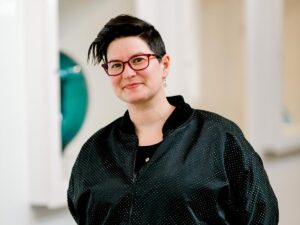
About the Artist: Vanessa Dion Fletcher

Vanessa Dion Fletcher is a Lenape and Potawatomi neurodiverse Artist; her family is from Eelūnaapèewii Lahkèewiitt (displaced from Lenapehoking) and European settlers. She uses porcupine quills, Wampum belts, and menstrual blood to reveal the complexities of what defines a body physically and culturally. Reflecting on an Indigenous and gendered body with a neurodiverse mind, Dion Fletcher primarily works in performance, textiles and video.

She graduated from The School of the Art Institute of Chicago in 2016 with an MFA in performance and a Bachelor of Fine Arts from York University in 2009. She has exhibited across Canada and the USA at Art Mur Montreal, Eastern Edge Gallery Newfoundland, The Queer Arts Festival Vancouver and the Satellite Art show in Miami. Her work is in the Indigenous Art Centre, Joan Flasch Artist Book Collection, Vtape, Seneca College, Global Affairs Canada and the Archives of American Art.

The artist would like to thank the following funders for support: Canada Council for the Arts, Ontario Arts Council and Toronto Arts Council.